Author: Ahmed Hussain
Nobody sat down and decided to solve a complex equipment problem with a 400-page PDF. It happened gradually, one revision at a time, until the document became too large to print and too slow to search and too generic to be useful at the moment someone actually needed it.
Walk into a hospital equipment room or a manufacturing plant during an unplanned maintenance event and you will usually find one of two things. Either a technician on the phone to a senior engineer, explaining symptoms while the engineer tries to visualize a machine they may not have touched in months. Or a technician scrolling through a PDF on a tablet, looking for the right diagram while a piece of equipment sits idle and a patient waits or a production line stops.
The documentation was written by experts who knew the equipment intimately. The problem is that it was written for people who also knew the equipment intimately. In the era when most complex equipment was serviced by a small number of highly trained specialists who came up through long apprenticeship programs, this was acceptable. That era is over.

Three things changed simultaneously and their intersection is where the field service cost problem actually lives.
First, equipment got more complex. A modern imaging system, a dialysis machine, or a high-throughput laboratory instrument has more software components, more configurable parameters, and more failure modes than its equivalent from fifteen years ago. The number of things that can go wrong, and the expertise required to diagnose and fix them, has grown significantly faster than the number of people trained to handle them.
Second, the specialist workforce thinned. Decades of decisions about hiring, training, and cost reduction have produced a field service workforce that skews toward generalists who cover broader territories and handle more equipment types. The deep specialist who spent twenty years working on one product line is becoming rare. The technician who covers three regions and eight product families is becoming common. That technician cannot carry deep expertise on every machine they service.
Third, customer expectations changed. Equipment downtime that was acceptable a decade ago is not acceptable now. A hospital that brings in an MRI cannot have it offline for two days while a senior engineer flies in. A pharmaceutical manufacturer running a validated production process cannot absorb extended downtime for a maintenance event that should take four hours. The tolerance for service delays has compressed precisely when the expertise required to avoid them has become harder to deploy.
The 400-page PDF was never the right answer. It was the only answer available at the time.
A digital twin of a piece of complex equipment is not a 3D rendering for marketing purposes, though it can produce those too. In a service context, it is an interactive, data-linked, configuration-aware model of the specific unit installed at the specific site.
That specificity is everything. When a field technician opens a digital twin-based service tool for the dialysis system in Bay 4 of a hospital, they are not looking at a generic illustration of a dialysis system. They are looking at a model of the specific machine at that site, with the specific modules installed, the specific software version running, and the specific service history attached. When they tap the component that is behaving unusually, the tool does not return a chapter from a manual. It returns the diagnostic path relevant to that component on that configuration, drawing on the service records of similar machines that have exhibited similar symptoms.
The difference in what the technician can do with this information, compared to what they can do with a PDF, is not marginal. It is structural. One of them requires the technician to translate generic instructions into specific actions for a specific machine. The other meets the technician where they are.
The business case for this kind of investment is usually made in one of three ways, and only one of them captures the real value.
The first framing is time-to-resolution. Digital twin-based service tools reduce the time it takes a field technician to diagnose and resolve a service event. The reduction is real and measurable, typically in the range of 25 to 40 percent for complex fault resolution. For equipment where downtime is expensive to the customer, this reduction translates directly into contract performance.
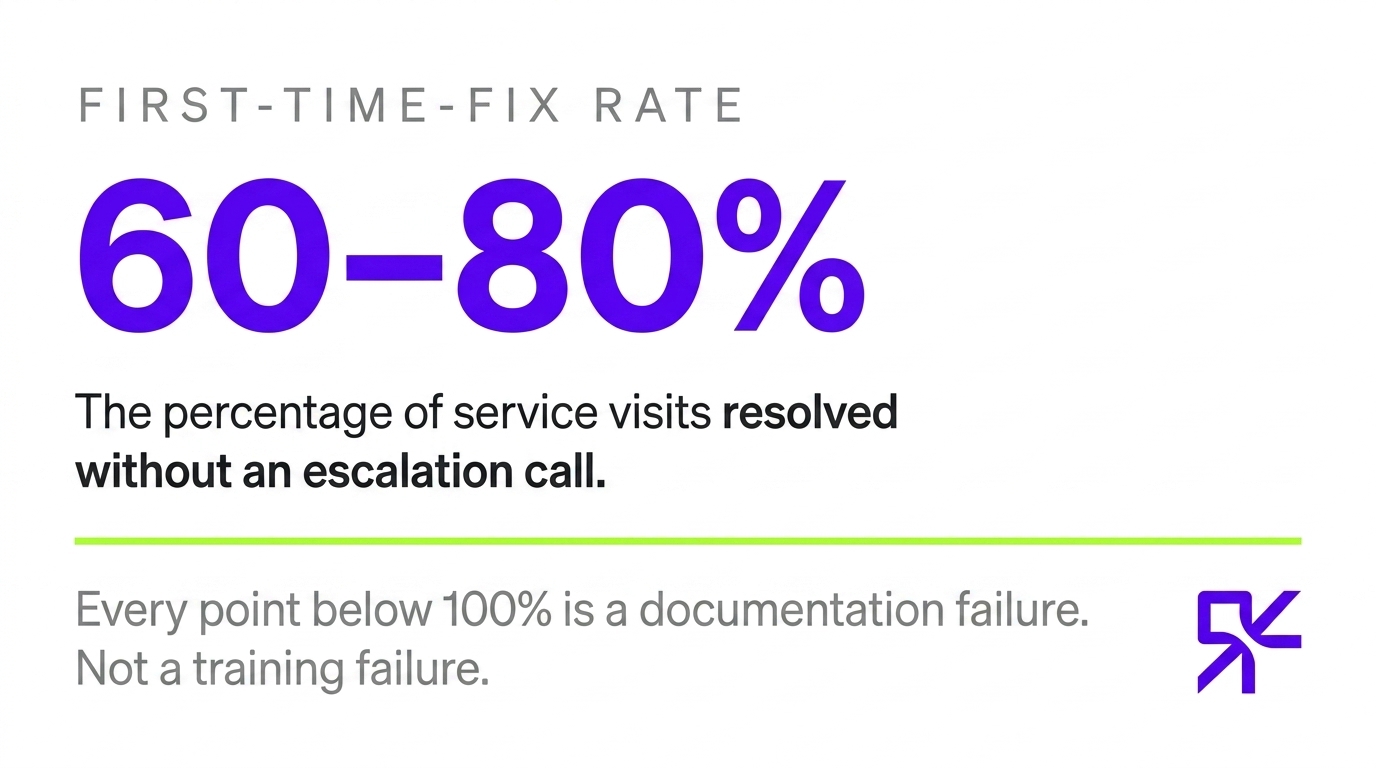
The second framing is escalation reduction. A meaningful portion of field service escalations, estimates run between 20 and 35 percent, involve a technician calling a senior engineer for guidance that the digital twin could have provided. Each escalation call costs both the technician's time and the engineer's time, and it slows the resolution. Reducing escalations by half has a cost impact that is straightforward to calculate once you know your average escalation cost per event.
The third framing, and the one that is most often overlooked, is training economics. Onboarding a new field service technician to competency on a complex product line takes months and costs significantly in trainer time, travel, and lost productivity. A digital twin-based training environment can compress this timeline because the technician learns the equipment by working with a model of it, disassembling virtual components, running simulated diagnostic sequences, and observing the consequences of different decisions, before they are ever dispatched to a customer site. The training cost reduction compounds every time a new technician is hired, and hiring rates in field service are not small.
The field service problem is not a technology problem. It is a documentation model problem that technology can now solve.
Companies that calculate only the first two framings often underestimate the return on investment by a significant margin. The training economics alone can justify the initial investment in many product categories, and the time-to-resolution and escalation benefits are ongoing returns on top of that.
The question worth asking is not whether digital twin technology is ready. It is. The question is whether your documentation model is building the right asset, or whether you are still producing the most expensive PDF your company owns.

A 3D model built for marketing will fail at service. This is the most common mistake companies make when they first approach digital twin work, and it is worth naming clearly.
A marketing twin is built to look impressive in a product launch video. The geometry is approximated. The surface detail is what the rendering engine needs, not what a technician diagnosing a fault needs. The model has no data layer connecting it to configuration management, service history, or parts inventory. It was never designed to be updated when the product is revised.
A service twin is built from engineering data. The geometry is accurate enough that a technician can use it to verify the correct orientation of a component before reinstalling it. The data layer is connected to the systems that know what configuration is installed at each site. The model is maintained alongside the product, not produced once and left to drift.
Building these two things from the same asset, which is both technically and commercially achievable when the architecture is designed correctly from the beginning, is how the investment pays back across more than one function. The marketing team gets the hero product visualization they need. The service team gets the guided troubleshooting tool they need. The training team gets the interactive environment they need. All from the same underlying asset, maintained in one place, by one team.
The alternative is building each of these things separately, which is what most companies do today. Three separate budgets, three separate vendors, three separate models that drift apart over time and need to be reconciled every time the product changes. The cost of the separate path is larger than most organizations realize because it is distributed across departments who are not looking at the total.

A mid-sized medical equipment manufacturer we worked with had a field service escalation rate they described as manageable. When we helped them quantify it, three things became clear. The average escalation event cost significantly more than they had estimated, primarily because they had not fully accounted for the senior engineer time on both ends of the call. The escalation rate was highest on their newest and most complex product line, which was also their fastest-growing revenue source. And a meaningful percentage of escalations were for faults that had been encountered before on similar units and for which a documented resolution path existed in their service records, but was not accessible to the field technician in a useful form.
The digital twin engagement addressed all three. It was not a technology deployment. It was a change in how service knowledge is captured, structured, and made accessible at the moment and in the form a technician needs it.
The question worth asking is not whether digital twin technology is ready. It is. The question is whether your documentation model is building the right asset, or whether you are still producing the most expensive PDF your company owns.
Citara Labs is a senior design and engineering studio. Our Digital Twin practice builds full-stack interactive product experiences for OEMs and capital equipment manufacturers, across sales, training, service, and marketing.