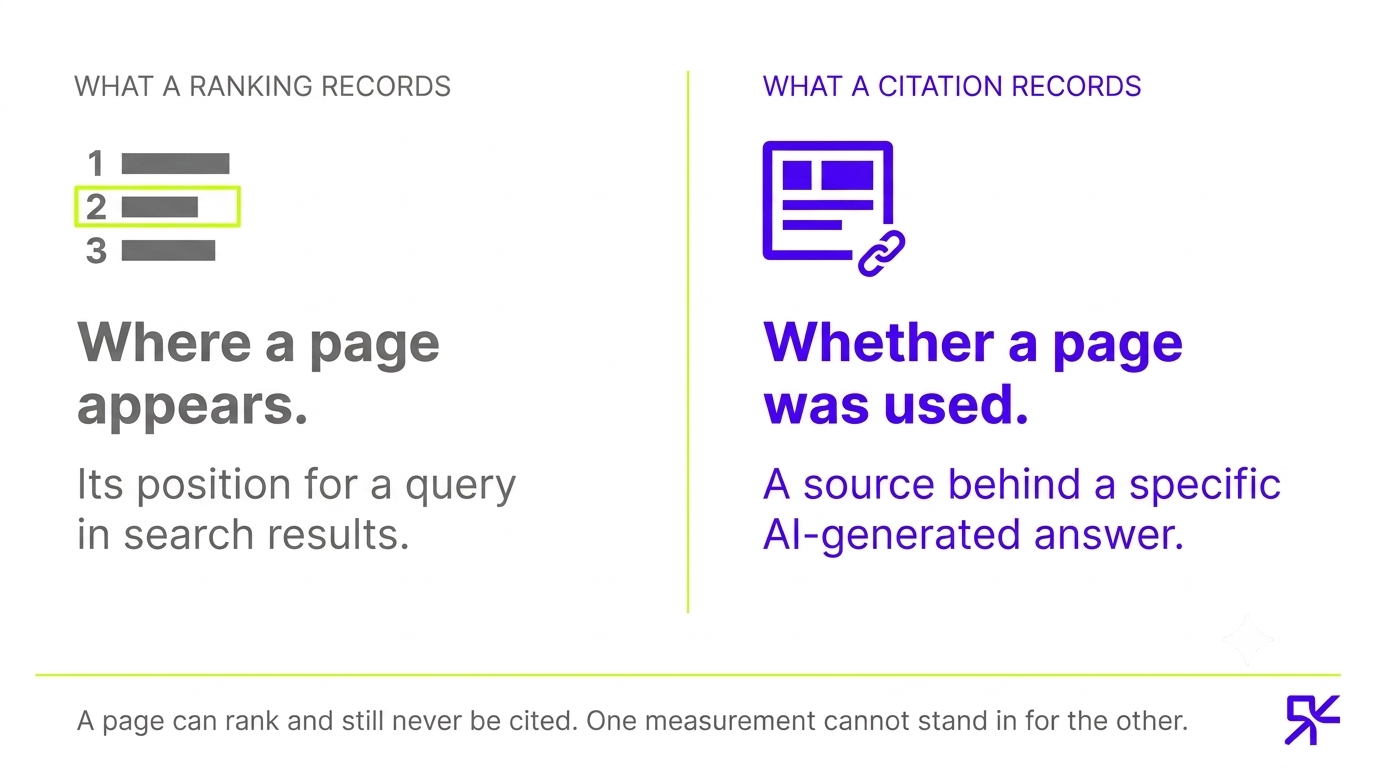
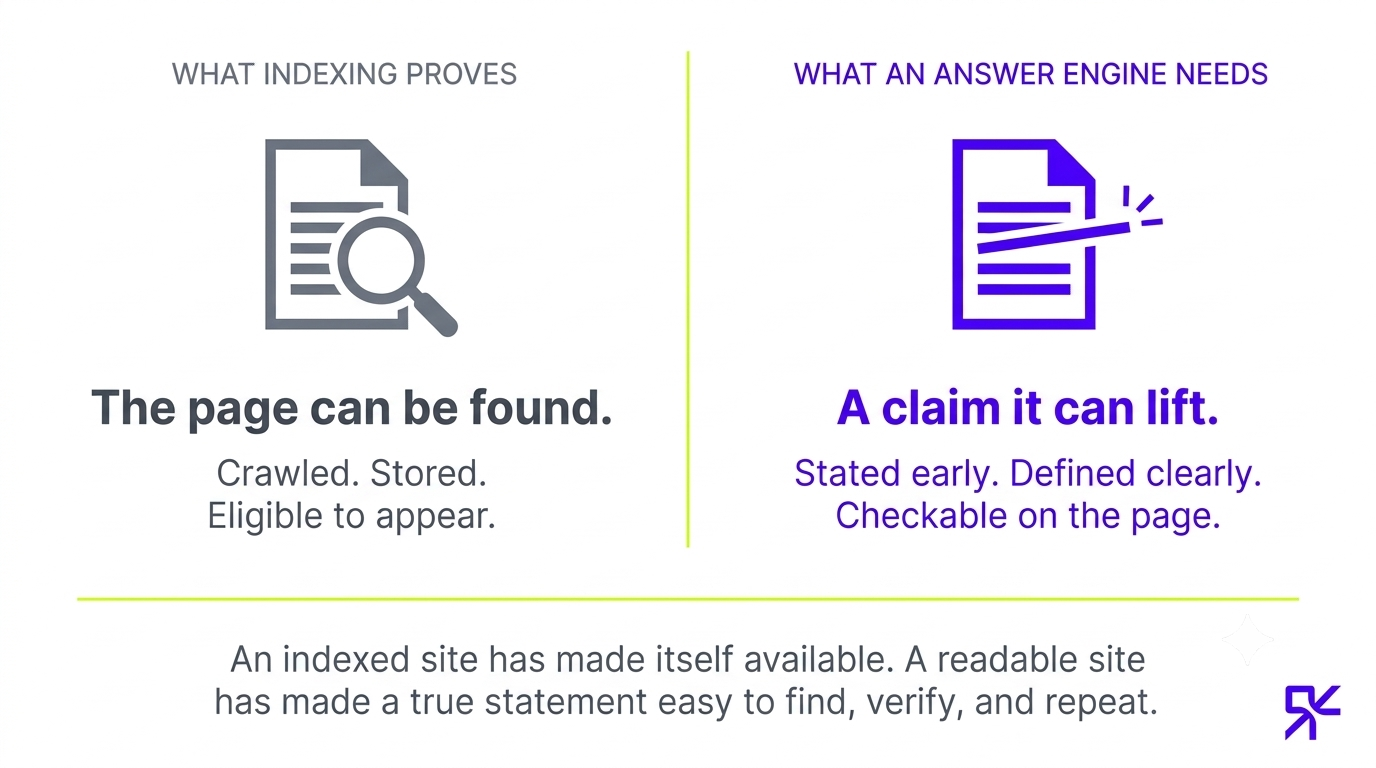
An answer engine does more than return a list of links. It retrieves sources, extracts information it can use, and writes a response. It may include citations, but the answer itself is assembled from what the system can interpret and support. Being indexed and being chosen for that answer are two different problems.
That distinction matters because a page can be technically available yet difficult to use. If its key point is buried, its terminology shifts between sections, or its claims depend on context elsewhere, a system may find the URL and still fail to extract a reliable statement from it. Availability is a starting condition, not evidence that a page is readable.
The difference is visible in user behaviour. Pew Research Center analysed the browsing data of 900 US adults in March 2025 and found that 18% of their Google searches produced an AI summary. People clicked a source cited in a summary in just 1% of visits. They clicked a traditional result in 8% of visits when a summary appeared, compared with 15% when it did not. The median summary was 67 words long.
Those figures do not tell us what any one company will gain or lose. They do show why a ranking report alone misses part of the change. When a short, composed answer satisfies the search, the page's job is not only to attract a click. It must also make a useful, accurate passage easy to find and repeat.
This is the mechanical core of answer engine optimisation, or AEO, and generative engine optimisation, or GEO. The labels are newer than the underlying problem: a system can only quote or paraphrase what it can identify, understand, and verify. Confident generalities are hard to use because they cannot be restated precisely without risking error.
Consider a page that says a company provides "end-to-end support for ambitious teams". That may communicate a mood to a human reader, but it does not specify the work, the audience, or the boundary of the offer. A more extractable description names the practice, says what it does, and distinguishes it from adjacent work. Specificity makes a claim usable. It does not guarantee citation.
A useful page structure helps preserve that specificity:
Give each URL one primary topic, and make the page's purpose clear in its title and headings.
Put the direct answer near the beginning, rather than making readers or systems infer it from a long introduction.
Use semantic HTML and a logical heading hierarchy, so the relationship between sections is explicit.
Define company, product, and practice names clearly, then use them consistently across pages.
Describe mechanisms in concrete terms: what happens, what information is used, and what the result is.
Keep structured data accurate and aligned with the visible text. Markup should describe the page, not make claims the page itself does not make.
Structured data is not a second, hidden version of the page. It is a machine-readable description of information that should already be visible to a person. If the schema says one thing and the page says another, the mismatch creates doubt rather than clarity.
The same principle applies to headings and prose. A heading such as "How the system works" is useful when the section explains the mechanism. A heading that promises an answer but leads to general positioning does not help either reader or machine. The page should make the relationship between question, answer, and evidence plain.

Google Search Central's guidance says there are no additional technical requirements for a page to appear as a supporting link in AI Overviews or AI Mode. A page must be indexed and eligible to appear in Google Search with a snippet. Google states plainly that no special optimisation is necessary, and separately advises that structured data must match the content visible on the page. The same documentation describes query fan-out, where the system issues multiple related searches across subtopics and data sources to build a response. That means a page may be retrieved for related questions, not only the one it was written for. Google's newer guide on generative AI features also warns against creating separate content for every variation of how people might search.
"No special optimisation is required" does not mean "nothing matters". It means there is no separate technical switch that buys entry. The quality of the underlying page still matters: can it be crawled, does it answer the question, and can its content be interpreted without guesswork?
Bing's Webmaster Guidelines are more direct about the content properties that support grounding. The guidelines define GEO as making content eligible to be grounded and referenced in AI responses, while stating that GEO does not guarantee grounding or citations. Microsoft added the term to that document in 2026, which is a fair measure of how young the discipline is. The guidelines ask for explicit facts that can be verified independently, clearly defined entities, one topic per URL, key information near the top, accurate structured data, and a correct title, meta description, and heading hierarchy.
The direction is consistent, even where the wording differs. Google describes eligibility and foundational search practices. Bing names the characteristics of content that can be understood and grounded. Neither promises that a particular page will be chosen.
There is a reason to avoid hiding the answer in the middle of a long page. Liu et al.'s 2023 paper, "Lost in the Middle: How Language Models Use Long Contexts", found that language models use information more effectively when it appears at the beginning or end of a long context, and less effectively when it sits in the middle. That finding concerns long model inputs, not website ranking. It is still a useful mechanical reason to place the answer early, where it has a better chance of surviving retrieval and synthesis.
The early GEO research is worth reading with the same care. Aggarwal et al.'s 2024 paper, "GEO: Generative Engine Optimization", introduced GEO and GEO-bench, and reported visibility gains of up to 40% from methods including citations, credible quotations, and statistics. That result came from a controlled testbed and a composite visibility score. It was not a forecast of clicks or traffic, and the reported effect varied by domain. It is evidence that presentation can affect measured visibility in an experiment, not a guarantee for a marketing plan.
Start with what buyers actually ask, not a list of keywords. Write down the 20 questions that come up in sales calls, product conversations, and customer research. For each one, identify the page that answers it. Mark questions with no page, and questions answered only in passing on a page about something else.
Then work through the gaps:
That last step is a simple observational measure, not a universal benchmark. Keep the questions and wording consistent between checks so you can see changes in the responses. Citations and clicks are different outcomes. Pew Research Center's findings make clear that a cited source may receive no visit at all, so a traffic-only report cannot describe citation visibility.

Crawler access is another separate check. OpenAI's crawler documentation separates OAI-SearchBot, which surfaces sites in ChatGPT search, from GPTBot, which collects content for model training. The two can be allowed or blocked independently in robots.txt. ChatGPT-User is different: it fetches pages when a user asks ChatGPT to, and OpenAI says robots.txt rules may not apply to it. A robots.txt review should be specific about which use of content the organisation intends to allow, and should not assume a rule stops every OpenAI visit.
For a deeper account of what influences selection, read our earlier essay on what AI answer engines actually cite. Our AI Practice works on the information and systems behind these questions, not on promises about what a platform will cite.
Nobody can promise a citation. Google describes the eligibility conditions for AI features, not guaranteed inclusion. Bing states plainly that GEO does not guarantee grounding or citations. Anyone selling guaranteed inclusion in a named model is selling something no platform will promise.
That is a useful boundary for procurement. Refuse a retainer priced around “AI visibility” if it comes with no before-and-after question set. Refuse a commitment to publish a fixed volume of content without a clear account of which buyer questions those pages answer. Refuse any promise of inclusion in a named model.
Some of the work will be technical. Some will mean deciding what the company actually calls its products and practices, and making those names consistent. None of it removes uncertainty about what an engine will choose. It makes the information more coherent for the people who need it, and easier for a machine to restate without changing its meaning.
An indexed site has made itself available. A readable site has made a true statement easy to find, verify, and repeat. The distinction is not a new trick. It is the difference between being present in the source material and being understood.