The call lasts forty-five minutes. A field technician is on site with a machine they have not seen in this specific configuration before. The machine is down. The customer is waiting. The service manual does not cover the modification made during commissioning. The senior engineer at the escalation line walks the technician through the diagnostic step by step. The machine comes back up. The visit is logged as resolved. The service manual is not updated. Nobody has time to update the service manual. Three weeks later a different technician is dispatched to the same site. The same machine fails. The same call happens.
Most service operations leaders who read that sequence recognise it immediately. Many have spent years trying to solve it by investing in technician training. Better onboarding. Longer certification programmes. More frequent refresher courses. The escalation rate improves slightly, then plateaus, then rises again when the product adds a new variant or the service team turns over. The investment is going into the wrong place. The technician is not the problem.

An escalation call happens when a technician encounters a situation they cannot resolve with the information available to them on site. The instinct in most service organisations is to interpret this as a knowledge gap. The technician does not know enough. Train them more. This interpretation is wrong in a specific and important way. The technician may know the product well. They may have completed the full certification programme and worked on dozens of units. What they do not know, and what no amount of training can give them, is the specific configuration of the specific machine in front of them.
Every complex physical product that is installed and commissioned in a customer site becomes a unique object. It has specific modifications made at installation. It has a service history that differs from every other unit of the same model. It may have been upgraded with components that were not part of the original design. The service manual, which was written for the product as it left the factory, describes a machine that may no longer exist in the form it takes at this particular site.
When the technician opens the manual and cannot find the guidance they need, it is not because they are undertrained. It is because the manual does not contain information about the machine in front of them. The escalation call that follows is not a training failure. It is a documentation failure. The organisation is paying a senior engineer forty-five minutes of their time to provide, verbally, the unit-specific information that should have been available in the documentation the technician was carrying.
Service documentation fails at scale for three reasons, and they compound each other. The first is the static file problem. A service manual is a document. It was accurate on the day it was written. Every decision made after that day is not automatically reflected in the document. The manual becomes less accurate over time. In a complex product with a long service life and regular engineering updates, the gap between what the manual describes and what the machine actually is can be substantial within eighteen months of the first installation.
The second is the variant coverage problem. Most service manuals are written for the base configuration of the product. Complex products often have dozens of variants, custom configurations, and market-specific modifications. New variants are added to the product portfolio faster than they are added to the documentation. The technician dispatched to a site with an uncommon variant may be working from a manual that has no guidance for the specific unit they are looking at.
The third is the installation divergence problem. Every installation is different. Site conditions, customer requirements, and commissioning decisions create a version of the product that is specific to that location. The service manual describes neither of them exactly. The technician at any site is working from a document that approximates the machine in front of them.
The escalation call is visible in the service budget as a cost. Forty-five minutes of a senior engineer's time. What is harder to see is the cost of the documentation failure that caused the call. The senior engineer who handles escalation calls is usually one of the most experienced people in the organisation. In most service operations, senior engineers handle between two and five escalation calls per day. That is between ninety minutes and nearly four hours of their time spent providing information verbally that should exist in the documentation.
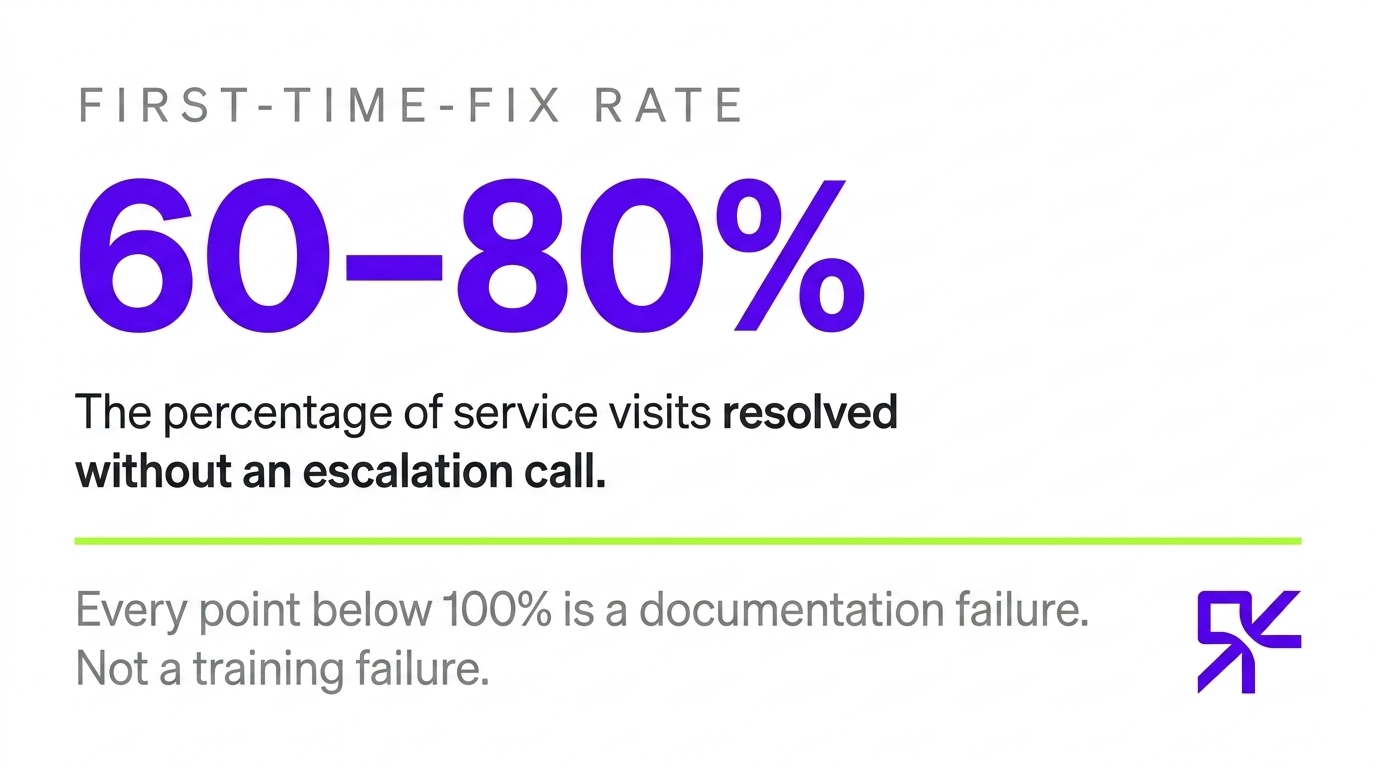
The first-time-fix rate, the percentage of service visits resolved without an escalation call, is the metric that captures this cost most directly. For most complex product service organisations, this rate sits between 60 and 80 percent. Every point below 100 percent represents a visit where the documentation failed the technician.

The solution to a documentation problem is not more documentation. More documentation, delivered in the same format that failed, produces the same result with more pages. The solution is documentation that knows what machine it is describing. A digital twin built for field service is a live model of the specific unit installed at the specific site, carrying the configuration data, the installation record, the service history, and the known fault patterns for that unit. When a technician opens the twin on a tablet on site, they are not looking at a generic representation of the product. They are looking at the machine in front of them, described accurately, updated to reflect everything that has happened to it since it left the factory.
The guided diagnostic that the twin provides runs against the actual unit configuration. If the machine was modified at commissioning, the diagnostic accounts for the modification. If the machine has a known fault pattern from previous service visits, the diagnostic surfaces that pattern before the technician begins. The senior engineer's verbal walkthrough is not replaced by the twin. It is made unnecessary, because the information that the engineer was providing verbally is now available in the documentation the technician is carrying.
A digital twin built for field service is the same underlying asset as the twin used in the sales demonstration, the training programme, and the marketing launch. The service twin is the most data-rich of the four use cases because it carries unit-specific information on top of the product model. That data richness is also what makes it the most valuable input to the training programme. A training module built from the service twin teaches technicians on the same model the field service tool uses.

For most service operations leaders reading this, the starting point is not a full digital twin programme. It is a specific question about a specific product. Which product in the portfolio has the highest escalation rate? What is the most common reason for escalation on that product? Is the reason a knowledge gap in the technician or a documentation gap in the service materials?
In almost every case where this question is examined carefully, the documentation gap is larger than the knowledge gap. The technician who made the escalation call could have resolved the fault on site if the documentation had described the specific unit they were looking at. That is the problem a field service digital twin is built to close. Not a training problem. A documentation problem. One that compounds every time a new variant ships, every time a unit is modified at installation, and every time a technician who has never seen this configuration is dispatched to a site that has one.
The escalation rate that seems like a training problem is, in most cases, a documentation problem waiting to be correctly diagnosed. The cost of misdiagnosing it is a training budget that grows while the escalation rate does not fall.